
One&Only Nyungwe House
Rooms on a tea plantation at the forest edge, for chimp trekking and the canopy walk.
Nyungwe National Park protects one of Africa's oldest montane rainforests: chimpanzees, 13 primate species, 300+ birds and a canopy walkway suspended above the treetops.
Nyungwe National Park covers about 1,019 km² of mountain rainforest in south-western Rwanda, stretching to the Burundi border and the shores of Lake Kivu. It is one of the oldest forests in Africa, and it survived the last Ice Age as a refuge, which explains its diversity. It has more than 1,000 plant species, including some 200 orchids, 13 primate species, about 310 bird species (with roughly 27 Albertine Rift endemics) and 75 mammal species. Some of the headwater streams draining its western slopes feed the Nile. Since 2020 the park has been co-managed by RDB and African Parks.
| Location | South-western Rwanda, bordering Burundi's Kibira National Park |
| Size | About 1,019 km² |
| Established | Forest reserve from 1933, national park since 2004 |
| Altitude | About 1,600–2,950 m |
| Wildlife | 13 primate species, 75 mammals, about 310 birds |
| Managed by | RDB and African Parks, since 2020 |
| World Heritage status | Inscribed on UNESCO's World Heritage list in 2023 |
Nyungwe's habituated chimpanzees are tracked in the main forest near Uwinka, or in Cyamudongo, a small forest fragment near Rusizi. Treks leave very early, around 5:00–5:30 am, because chimps move fast once they leave their night nests. Sightings are good, but the steep terrain and fast-moving chimps make it more demanding than in Kibale. See Nyungwe chimp trekking.
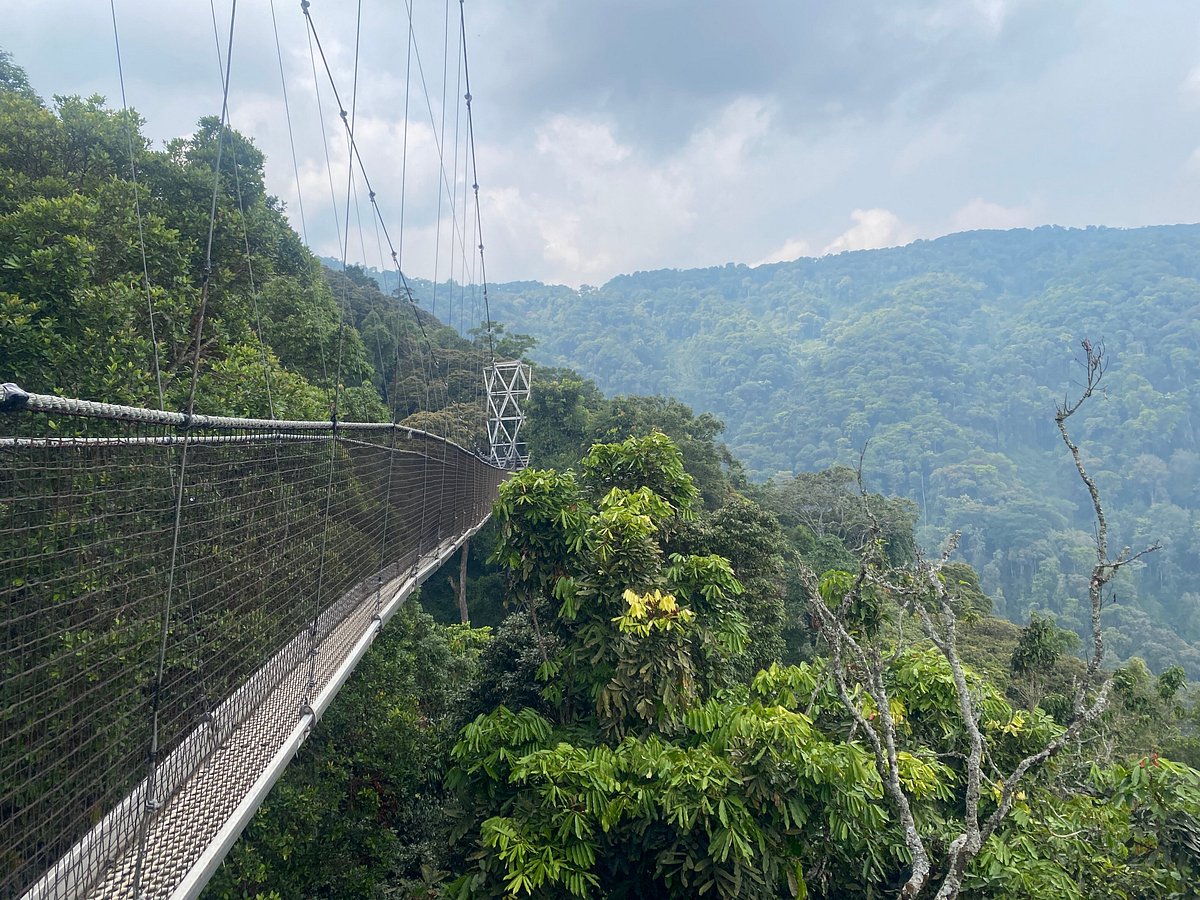
East Africa's first canopy walkway hangs about 50 metres above a forested ravine near Uwinka. It is roughly 160 metres long and supported by steel cables, and the walk to it takes about 2 hours in total. From it, you look into treetops at eye level with turacos, sunbirds and, if you are lucky, monkeys moving through the branches. It is safe for anyone comfortable with heights.
From Kigali it takes about 5–6 hours by road via Huye (with the Ethnographic Museum on the way). Alternatively, fly to Kamembe near Rusizi and drive 1 hour. From Lake Kivu's Karongi it is about 2½ hours. See combining gorillas with Nyungwe chimps.
Nyungwe has an exceptional variety of primates: chimpanzees, Rwenzori (Angola) colobus, L'Hoest's monkeys, grey-cheeked mangabeys, blue monkeys, silver monkeys, golden monkeys (rare here), red-tailed monkeys, Dent's mona monkeys, olive baboons, vervets, and nocturnal bushbabies and pottos. The colobus troops are extraordinary, sometimes 300–400 animals together, among the largest arboreal primate groups in Africa.
Treks leave at dawn from Uwinka, Gisakura or Cyamudongo, depending on where the chimps are. Groups are small, and the walk can be steep and fast, following chimps through the forest and down into valleys. Once found, you spend one hour with them. Sighting rates are good but not as reliable as Kibale's, and the forest canopy makes photography challenging. Cyamudongo, a separate forest fragment near Rusizi, often gives good views because the chimps are confined to a smaller area. See chimpanzee trekking.
| Trail | Length or time | Highlights |
|---|---|---|
| Igishigishigi (canopy walk) | About 2 km, 1–2 hours | The canopy walkway |
| Isumo waterfall | About 10 km, 3–4 hours | Tea estate, forest, a 15 m waterfall |
| Umuyove | About 6 km, 3 hours | Giant mahogany trees, a waterfall, primates |
| Bigugu | About 7 km, 4–6 hours | Nyungwe's highest peak (2,950 m), montane flora |
| Imbaraga | About 10 km, 6 hours | Waterfalls and deep forest |
| Congo Nile Divide | Multi-day | A long-distance trek across the park |
See our 3-day Rwanda chimps and Lake Kivu tour.
Nyungwe is a rainforest, with rain possible in every month. The drier months (June–August and December–February) are best for hiking and chimps. The wet season brings lusher forest and more flowering orchids, but muddier trails. Temperatures are cool, around 10–20 °C, so bring layers.
The main road from Kigali runs south to Huye, then west through the forest to Rusizi, with park entrances along it. The drive takes 5–6 hours and passes cultural sites at Nyanza (the King's Palace Museum) and Huye (the Ethnographic Museum). RwandAir flies Kigali to Kamembe near Rusizi in about 40 minutes, and the park is 1 hour's drive from there. From Lake Kivu, it is 2½–3 hours from Karongi along the lakeshore road.
Nyungwe is Rwanda's most important birding site, with about 310 species, including around 27 Albertine Rift endemics. Highlights include the red-collared mountain babbler, Rwenzori turaco, handsome francolin, regal sunbird, Rwenzori double-collared sunbird, Archer's robin-chat, dusky crimsonwing, strange weaver and Grauer's warbler. The Uwinka trails, the Kamiranzovu swamp and the Bigugu trail are the classic routes. A specialist bird guide is recommended. See birding safaris.
At the western edge of the forest, the bright green Gisakura tea estate contrasts sharply with the dark rainforest. Visits to the tea factory explain how Rwandan tea is grown, picked and processed, and colobus monkeys are often seen in the patches of forest within the estate. Many visitors stay nearby.
Nyungwe is one of Africa's most important montane forests. It is a water catchment for both the Nile and Congo river systems, and it provides much of Rwanda's water. Since 2020, African Parks has co-managed the park with RDB, strengthening law enforcement, community partnerships and tourism. Its inscription as a UNESCO World Heritage Site in 2023 recognised its global importance.
Kibale in Uganda is flatter, has more habituated chimps and gives higher sighting rates, making it better for guaranteed chimp encounters. Nyungwe is more mountainous and wild, offers the canopy walkway and the colobus super-troops, and fits naturally into a Rwanda circuit. Primate enthusiasts often visit both.
Nyungwe's Rwenzori colobus live in some of the largest monkey groups in Africa. On a guided walk, you track a troop of hundreds moving through the canopy, leaping between trees with their long white shoulder hair streaming out. Tracking is usually easier and shorter than chimp trekking, which makes it a good activity for younger visitors or those who want a gentler forest experience.
The walkway itself is about 160 m long and 50 m high. The guided walk there and back takes about 2 hours.
Kibale has higher sighting rates and easier terrain. Nyungwe adds the canopy walk and huge colobus troops, and it fits a Rwanda itinerary.
Two nights: one day for chimps and one for the canopy walk or waterfall.
Yes. Nyungwe was inscribed on UNESCO's World Heritage list in 2023, together with Rwanda's genocide memorial sites.
Rarely. For golden monkeys, visit Volcanoes National Park or Mgahinga.
By road in 5–6 hours via Huye, or by a 40-minute flight to Kamembe followed by a 1-hour drive.
Rain gear, warm layers, sturdy boots, insect repellent and binoculars. It is cool and wet in the forest.
Usually around 5:00–5:30 am, depending on where the chimps are, so stay close to the trailhead.
The walkway is solid and fenced with netting, but it sways slightly and hangs about 50 m above the ground. Most visitors, even those nervous of heights, find it manageable.
Not practically. It is 5–6 hours each way, so stay at least one night, and ideally two.
Rooms on a tea plantation at the forest edge, for chimp trekking and the canopy walk.
Chimps and the canopy walk in Nyungwe, then Lake Kivu.
The full Rwanda circuit: Big Five, gorillas, lake and chimps.
7-Day Rwanda Adventure safaris takes you through the journey to Nyungwe for a canopy walk and chimpanzee trek.