
Bwindi Gorilla Trekking from Kigali: There’s a moment on every Bwindi gorilla trek when the forest goes quiet. The birds stop. Your guide raises a hand. Ten meters ahead, a silverback lifts his head from the vines and looks straight at you. Time stops. Your camera shakes. And in that second, you understand why people fly 12 hours, cross borders, and spend $800 just for one hour in the forest. Now imagine reaching that moment after a 4-hour drive instead of a 10-hour ordeal. That’s the difference Kigali makes.
More travelers in 2026-2027 are landing in Kigali, Rwanda and trekking Bwindi Impenetrable Forest in Uganda. Not because they love border crossings. But because it’s faster, cheaper, and less exhausting. Kigali Airport is 4 hours from Bwindi. Kampala is 10 hours. Rwanda’s gorilla permit costs $1,500. Uganda’s costs $800. Same gorillas. Same DNA. Same life-changing eye contact. Different price tag and different road.At Fuga Tours & Travel, we’ve guided over 400 clients from Kigali to Bwindi since 2020. The feedback is always the same: “I wish someone had told me how easy this route was.” So here’s the full story. No bullet points. No fake “Day 1, Day 2” outline. Just what you actually need to know if you want to trek Bwindi gorillas from Kigali.
The Road From Kigali Tells a Different Story
When you leave Kigali at sunrise, the city drops behind you in 20 minutes. Rwanda is a country of hills. Every turn reveals another ridge covered in banana plantations, tea fields, and red soil that glows in the morning light. The road to Cyanika border is smooth, wide, and clean. You’ll pass women carrying baskets on their heads, kids in school uniforms, and motorbikes loaded with more than physics should allow. Crossing into Uganda at Cyanika takes less time than airport immigration. Rwanda stamps you out. You walk 50 meters. Uganda stamps you in. Your Fuga driver is waiting on the Uganda side with cold water and your name on a sign. From there the road climbs toward Kisoro, the “Switzerland of Uganda.” The air gets cooler. The Virunga volcanoes appear in the distance. If it’s a clear day you’ll see three countries at once: Rwanda behind you, Uganda under your tires, and DRC across the valley.
This is not the bone-shaking Kampala-Mbarara-Kabale road. This is a 4-hour drive that feels like a journey, not a punishment. You arrive at your lodge near Bwindi with time to breathe, have lunch, and actually look at the forest you’ll enter tomorrow. That matters. Gorilla trekking is physical. Arriving fresh instead of exhausted after 10 hours in a car changes your whole experience.
The $700 Decision That Changes Nothing About the Gorillas
Let’s talk about money without pretending it doesn’t matter. Uganda Wildlife Authority charges $800 for a mountain gorilla permit. Rwanda Development Board charges $1,500. That’s a $700 difference per person. For a couple, it’s $1,400. For a family of four, it’s $2,800.What do you get for the extra $700 in Rwanda? A shorter drive from Kigali to Volcanoes National Park, about 2.5 hours. What do you lose? Nothing about the gorillas. The mountain gorillas in Bwindi and Volcanoes are the same subspecies. They share 98.4% of human DNA. They live in the same altitude, eat the same plants, and have the same social rules. The one hour you spend with them is identical. The only difference is the country your feet are standing in when it happens. Bwindi has 22 habituated gorilla families. Rwanda has 12. Bwindi’s forest is older, denser, and called “Impenetrable” for a reason. The trek feels wilder. The forest feels older. And because Uganda has more families, it’s easier to find last-minute permits when Rwanda is sold out six months ahead. That $700 you save in Uganda pays for your lodge, your meals, your transport from Kigali, and still leaves money for a safari in Queen Elizabeth or a hot air balloon in Murchison. This is why smart travelers in 2026-2027 are choosing Bwindi from Kigali. They’re not cutting corners. They’re cutting waste.
Crossing the Border is Part of the Adventure, Not a Hassle
Most people fear border crossings in Africa. Photos of long queues and bribes. The truth at Cyanika is different. It’s small, quiet, and run by officers who see gorilla trekkers all day. You’ll need three things: your passport, your yellow fever certificate, and your Uganda e-visa or East Africa Tourist Visa. Fuga Tours sends you a WhatsApp checklist two weeks before travel and reminds you twice. We also send a sample of the hotel confirmation letter UWA wants to see, so you don’t get stopped for paperwork. When you reach the Uganda side, your Fuga driver handles the vehicle paperwork. You just walk through with your passport. The whole process usually takes 15-20 minutes. Compare that to the hour you’ll spend waiting for luggage at Entebbe Airport. By the time you’ve crossed, you’re already in Uganda and only 1 hour from Kisoro town, where your lodge is waiting.The border is also where the landscape changes. Rwanda’s hills are manicured and terraced. Uganda’s side is wilder, more forested. You’ll know you’ve entered Bwindi country when the trees get taller, and the air smells like wet leaves. That’s the same smell the gorillas live in. You’re getting closer.
Why Bwindi From Kigali Feels More Intimate
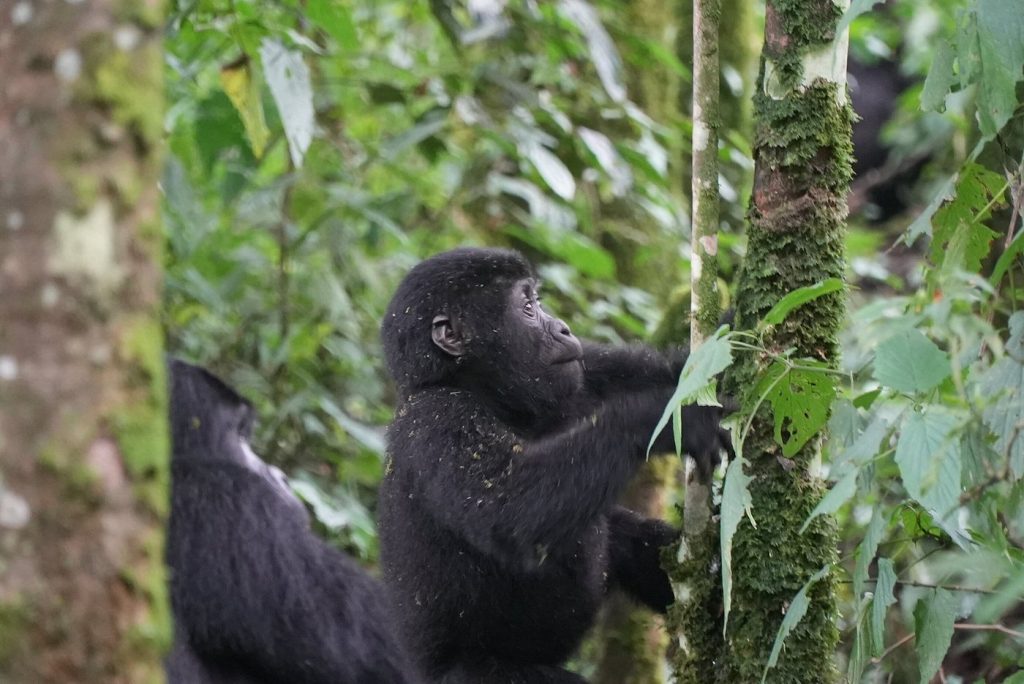
Bwindi Impenetrable National Park is not a zoo. It’s 331 square kilometers of steep valleys, tangled vines, and trees that have stood for 500 years. When you trek, you don’t follow a boardwalk. You follow gorilla trails. Sometimes you crawl under branches. Sometimes you slide down mud slopes holding onto roots. The forest is loud with insects, birds, and the sound of your own breathing .Because Kigali gets you to Bwindi faster, you arrive less tired. That means when your guide whispers “the gorillas are 200 meters ahead, move quietly,” you actually can move quietly. You can crouch without your legs shaking. You can hold your camera steady when the silverback steps into a clearing. And because Uganda has more gorilla families than Rwanda, the groups are often smaller in terms of tourists. Only 8 people visit one gorilla family per day. In Rushaga sector, which is closest to Kigali, there are 15 families. That means 120 people can trek per day, but spread across different parts of the forest. You won’t feel like you’re in a line. You’ll feel like you’re the only group who found them.
Gorilla Trekking in Bwindi Impenetrable Forest

There’s no photo that prepares you. No documentary, no YouTube video, no friend’s story told over coffee. Then you’re standing in Bwindi Impenetrable Forest, your shirt stuck to your back, mud on your boots, and 10 meters away a 200kg silverback rips bark off a tree with his teeth and glances at you like you’re the one who’s out of place. Your breath catches. Your guide touches your arm. And for 60 minutes, the rest of the world stops existing. That’s gorilla trekking in Bwindi. Not a hike. Not a safari drive. A face-to-face encounter with one of your closest relatives that has lived in this forest for 8 million years while humans built cities, invented phones, and forgot how to be quiet.Bwindi Impenetrable National Park holds nearly half the world’s remaining mountain gorillas. About 450 of the 1,060 left on Earth live here, in a forest so dense that UNESCO named it “Impenetrable” and locals called it “The Place of Darkness.” You don’t come to Bwindi to check a box. You come because somewhere deep down you know that looking a wild gorilla in the eye is a privilege that might not exist for your children.
The Hour That Rewrites Your Memory
Uganda Wildlife Authority gives you exactly one hour with the gorillas. It sounds short. It isn’t. In 60 minutes, you’ll see more behavior, more personality, more family drama than you thought possible. You’ll watch a mother peel stems with the same concentration you use to peel an orange. You’ll see a 3-year-old infant try to climb his mother’s back, fall off, try again, while she ignores him like every mother on Earth. You’ll hear the silverback cough a deep rumble that means “I’m here, this is my family.” You’ll see blackback males wrestling and playing, learning the strength they’ll need to lead a family someday.
The gorillas ignore you after the first 5 minutes. You’re not a threat. You’re just another animal in the forest that isn’t trying to steal their food. So they get back to living. Eating. Grooming. Napping. Playing. And you realize how much of their day is spent doing ordinary things, just like us. Photographers try to take pictures. But after a few shots, most people put the camera down. Because you can’t capture the sound of a silverback chewing bamboo. You can’t capture the way the forest goes silent when he stands up. You can’t capture the feeling of being accepted for one hour by creatures who have every reason to run from humans. When the ranger says “time is up,” you feel it physically. Like leaving a room where something important is happening. You walk back down the hill and your legs hurt, but you don’t care. Because you just spent an hour in a world that most people will only see on a screen.
The Cost, The Permit, and Why It’s Worth Every Dollar
Uganda gorilla permit costs $800 for foreign non-residents. That’s set by the Uganda Wildlife Authority and doesn’t change. It sounds like a lot until you break it down. That $800 funds anti-poaching rangers who walk the forest 365 days a year. It pays community projects so local people don’t cut the forest for firewood. It funds veterinary teams who treat gorillas when they get sick. And it limits the number of humans who can stress the gorillas each day to just 8 people per family. Compare that to Rwanda’s $1,500 permit for the same animal, same DNA, same experience. Or compare it to what you spend on a weekend in Dubai or a new phone you replace in 2 years. The gorilla encounter stays with you for life. Fuga clients tell us 3 years later that the trek is still the best thing they’ve ever done.
Permits sell out 6-12 months ahead for June-August and December-January. But they also open last-minute when people cancel. Fuga Tours has live access to the UWA system. If you send us your dates and passport scan, we check daily and WhatsApp you the second a permit drops. We’ve secured permits for clients who landed in Entebbe 48 hours before trekking. We won’t promise what we can’t deliver, but we will fight for you.
What Trekking in Bwindi Actually Feels Like

Let’s be honest. It’s hard. Bwindi sits at 1,160 to 2,607 meters altitude. The forest is on steep hills. It rains often. The ground is muddy. You will be tired.But difficulty is part of why the experience is sacred. If gorillas lived next to a parking lot, they wouldn’t be gorillas anymore. The effort you put in to reach them is what makes the moment matter. You earn it.Fitness matters, but you don’t need to run marathons. If you can walk 3 hours uphill with breaks, you can trek. Fuga arranges porters for $15-20. They’re local men who know every root and rock on the trail. They’ll carry your bag, give you a hand on slippery sections, and tell you stories about growing up next to the park. Hiring a porter isn’t just help for you. It’s income for a family in a region with few jobs.Age isn’t a barrier either. The minimum age is 15, set by UWA to protect both gorillas and children. The oldest client Fuga guided was 78. He took breaks, used a walking stick, and still stood crying when he saw the silverback. The rangers set the pace. No one gets left behind.
The Forest Is the Second Character in the Story
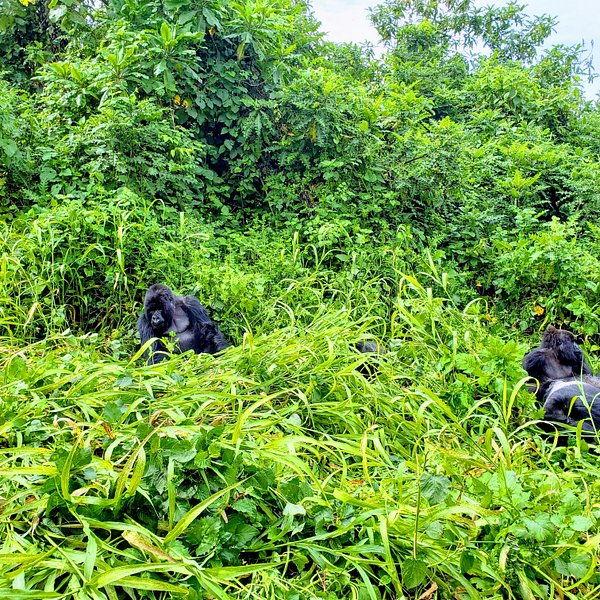
Bwindi isn’t just about gorillas. The forest itself is ancient. Some trees are 500 years old. The air smells like moss and damp earth. Colobus monkeys swing overhead. Forest elephants leave footprints. Over 350 bird species live here, including 23 Albertine Rift endemics you can’t see anywhere else.Your ranger will point things out if you ask. He’ll show you medicinal plants locals use. He’ll explain how gorillas build new nests every night from branches. He’ll tell you which birds mean rain is coming. For many clients, the walk through the forest is almost as powerful as the gorillas at the end. Because you realize this whole ecosystem exists because of these animals. Protect the gorillas, you protect the forest. Protect the forest, you protect the water that millions of Ugandans drink downstream. That’s why your $800 matters beyond the one hour. It’s an investment in keeping this place wild.
Why Book Bwindi Gorilla Trekking With Fuga Tours & Travel
You can try to book everything yourself. UWA permit, lodge, driver, border paperwork. But Bwindi is remote. Phone signal drops. Roads get blocked by rain. Lodges near the park HQ fill up fast because only 8 people trek per family per day. Fuga Tours exists to remove that stress. We’re a Uganda Tourism Board-licensed operator. When you book Bwindi with Fuga, you’re not buying a package. You’re buying a team that knows every ranger, every lodge manager, every shortcut around traffic.
We secure your permit and email you the scanned UWA receipt so you know it’s real. We match you to the right sector based on your fitness and dates. Rushaga for groups and last-minute bookings. Buhoma for first-timers who want classic Bwindi. Nkuringo for views and fewer crowds. We book lodges 20-40 minutes from park headquarters so you sleep in, not wake at 4am.
Our drivers meet you at Entebbe Airport or Kigali Airport if you’re coming from Rwanda. They handle border crossing, park fees, packed lunch, water, and that moment when you’re too tired to think and just need someone to say “we’re almost there.”And if something goes wrong — flight delayed, permit canceled, road blocked — Fuga fixes it. We have backup vehicles, backup lodges, and direct phone lines to UWA. You just focus on the gorillas.
The Truth No One Tells You Before You Go
You’ll come back from Bwindi changed. Not in a dramatic movie way. In a quiet way. You’ll look at your phone differently. You’ll be more patient with people. You’ll remember what it felt like to be quiet for one hour and just observe. Kids ask clients “what was the best part?” They expect “the silverback.” But adults usually say “the silence.” Or “how gentle they were.” Or “how much they reminded me of us. ”Gorilla trekking in Bwindi is expensive. It’s tiring. It requires planning. But endangered animals with 1,060 left on the planet should be hard to see. If it was easy, there’d be none left. So if you’re reading this from Kampala, Nairobi, London, or New York, and wondering if you should go — go. Not next year. Not when you’re fitter. Now. Because the forest is still there. The gorillas are still there. And for $800 plus the courage to walk into the green, you can stand 7 meters away from a creature that shares your ancestors and your future.
Fuga Tours & Travel is ready when you are.
WhatsApp “BWINI GORILLAS” + your dates to +256 79 4462014 Send your passport scan. We’ll check permits and reply in 30 minutes with real options, real prices, no fake promises. Come meet your cousins in Bwindi. The forest is waiting.