
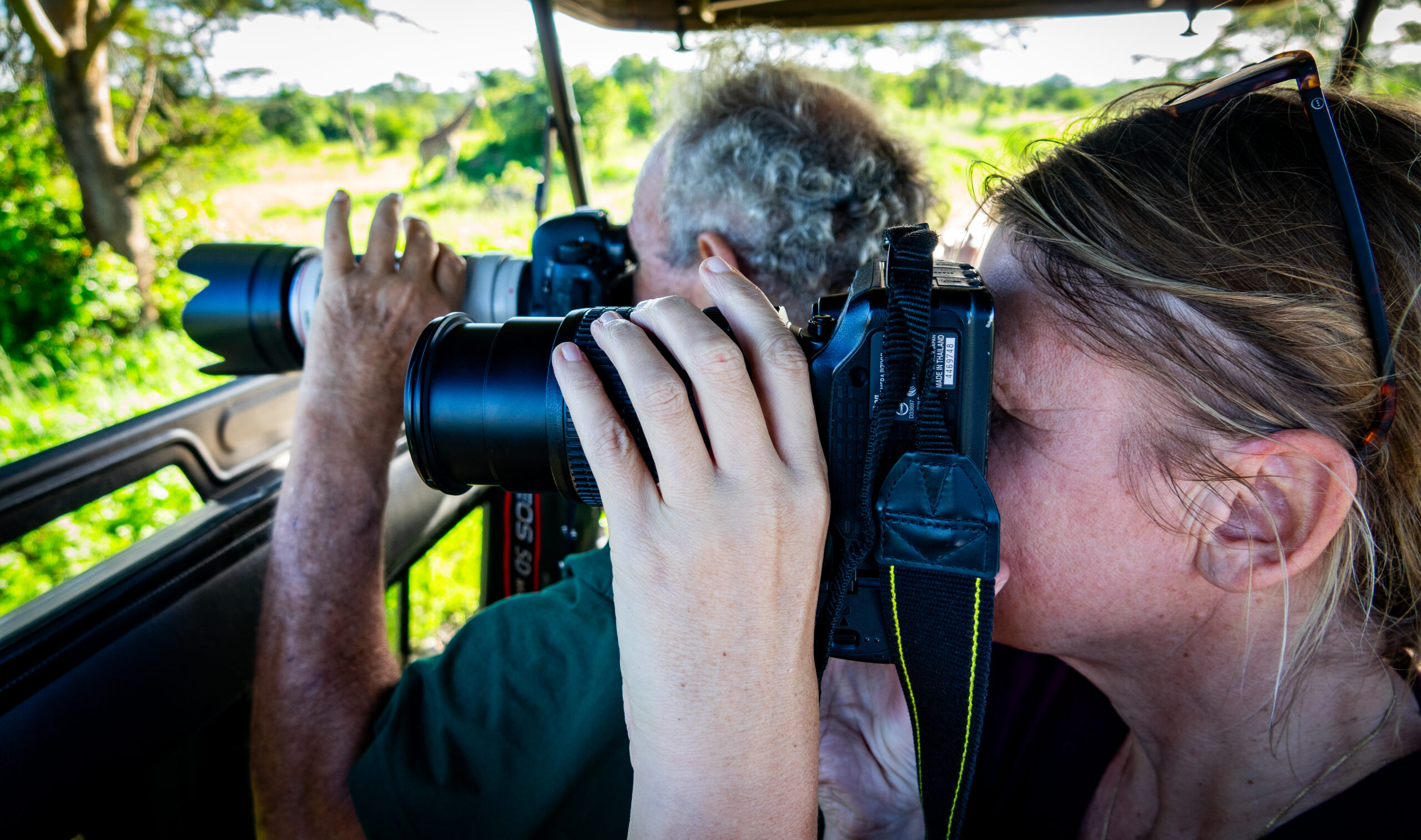
Best Binoculars for a Birding Safari in Uganda: A Complete Guide, Uganda is one of Africa’s most rewarding birding destinations, with an extraordinary variety of habitats ranging from tropical rainforests and wetlands to savannah, lakeshores and montane forests. From the famous shoebill at Mabamba Swamp to the Great Blue Turaco in Bwindi, African Green Broadbill in montane forests, and numerous kingfishers, hornbills and weavers, a good pair of binoculars can make the difference between simply hearing a bird and actually seeing its colors, markings and behavior.
Choosing binoculars for a Uganda birding safari, however, can be confusing. There are hundreds of models, different magnifications, lens sizes and price ranges.
For most travelers, 8×42 binoculars are the best all-round choice for birding in Uganda. They provide a good balance between brightness, field of view, magnification, comfort and portability. Shoebill Uganda Bird Tours
This guide explains what to look for and recommends some of the best binocular options for different budgets and birding styles.
Why Binoculars Are Important on a Uganda Birding Safari
Many Ugandan birds are small, fast-moving or hidden within vegetation. Even when a bird is relatively close, you may struggle to identify it with the naked eye.
Binoculars allow you to:
- Identify birds from a safe distance
- See plumage colors and patterns
- Observe birds without disturbing them
- Find birds hidden in dense vegetation
- Watch canopy species in forests
- Identify distant waterbirds and raptors
- Observe bird behavior
- Enjoy birds around lodges and camps
- Reduce the need to approach wildlife
This is particularly important in places such as Bwindi Impenetrable National Park, Kibale Forest, Queen Elizabeth National Park, Murchison Falls National Park, Semuliki National Park, Mabamba Wetland and Lake Mburo National Park.
What Are the Best Binoculars for Birding in Uganda?
For most travelers, our first recommendation is:
8×42 binoculars
The 8×42 configuration is popular because the 8x magnification provides a relatively wide and steady view, while the 42 mm objective lenses allow plenty of light to reach your eyes.
This combination is especially useful when birding in forests, wetlands and during early-morning game drives. Birdwatching organizations and optics guides commonly recommend 8x or 10x binoculars, with 8x particularly useful in woodland and lower-light conditions. RSPB Shop
Why 8×42 works so well in Uganda
8x magnification helps you locate and follow moving birds without making the image excessively difficult to hold steady.
42 mm objective lenses provide good light-gathering ability without making the binoculars excessively large.
The result is an excellent all-purpose binocular for a safari that combines forest birding, wetlands and open savannah.
8×42 vs 10×42: Which Is Better for Uganda?
This is one of the most common questions asked by birding travelers.
| Feature | 8×42 | 10×42 |
|---|---|---|
| Magnification | 8x | 10x |
| Field of view | Wider | Narrower |
| Image stability | Easier | More sensitive to movement |
| Low-light performance | Excellent | Good |
| Forest birding | Excellent | Good |
| Wetlands | Excellent | Excellent |
| Distant birds | Good | Better |
| Beginner friendly | Excellent | Good |
| General Uganda safari | Best choice | Good alternative |
An 8×42 is generally better if you will be walking through forests and looking for fast-moving birds in branches.
A 10×42 can be useful when watching distant birds across open landscapes or wetlands. The extra magnification provides more detail, but the narrower field of view can make it harder to initially locate a bird. RSPB Shop
Our recommendation
If you are buying just one pair for your Uganda safari, choose 8×42.
If you already own a good 10×42, however, there is no need to buy another pair simply for your trip.
Best Binoculars for a Uganda Birding Safari
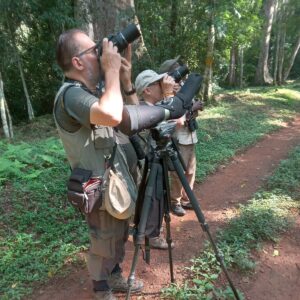
Below are several binoculars worth considering at different price levels.
1. Nikon Monarch M7 8×42 – Excellent Mid-Range Choice
The Nikon Monarch M7 8×42 is a strong option for serious birders who want excellent optical performance without moving all the way into the most expensive premium binoculars.
It offers a wide field of view and high-quality optics that are particularly useful when searching for birds in forest canopies.
Best for:
- Serious birders
- Forest birding
- Long birding days
- Travelers wanting high optical quality
- Birders who want one binocular for multiple African destinations
The Monarch M7 is frequently recommended among mid-range birding binoculars. Perch and Glass
Nikon Monarch M5 8×42 – Great Value for Serious Birders
The Nikon Monarch M5 8×42 is another excellent choice.
Its optical performance makes it suitable for identifying birds where subtle differences in plumage or markings matter.
It is particularly attractive for travelers who want to invest in good binoculars without paying premium prices.
Ideal for:
- Uganda birding safaris
- Forest birding
- Experienced birders
- Travelers who expect to use their binoculars regularly after the safari
Vortex Diamondback HD 8×42 – Excellent Value
The Vortex Diamondback HD 8×42 is worth considering if you want good performance at a more accessible price.
Its combination of magnification, objective lens size and compact handling makes it suitable for safari travel.
It is a particularly good option for travelers who don’t want to spend a fortune on optics but still want binoculars capable of serious birding.
The model is regularly highlighted as a value option in current birding binocular comparisons. Perch and Glass
Best for:
- First-time safari birders
- Travelers on a moderate budget
- General wildlife viewing
- Birding and game viewing combined
- Celestron TrailSeeker ED 8×42 – Excellent All-Rounder
The Celestron TrailSeeker ED 8×42 is another strong choice for birding.
Its 8x magnification provides a wide view for locating moving birds, while ED glass is designed to improve color and image detail. Current birding reviews rate it highly as an all-purpose 8×42 option.
Why consider it?
- Good field of view
- ED optical glass
- Good close-focus capability
- Waterproof construction
- Suitable for long birding sessions
- Useful for both birds and general wildlife
This can be an excellent choice for someone who wants a versatile pair for both birding and safari game viewing.
Celestron Nature DX 8×42 – Budget-Friendly Option
If you are new to birding and don’t want to spend too much money, the Celestron Nature DX 8×42 is worth considering.
You don’t necessarily need premium binoculars to enjoy a Uganda birding safari. A good entry-level 8×42 can provide a significant improvement over viewing birds with the naked eye.
Best for:
- Beginners
- Occasional birders
- Budget-conscious travelers
- First safari binoculars
Current birding comparisons commonly position the Nature DX among the better budget choices.
Premium Binoculars for Serious Birders
If birding is the main purpose of your trip and you are prepared to invest significantly more in optics, premium binoculars can provide exceptional image quality.
Some of the high-end options include:
Swarovski NL Pure 8×42
A premium choice for birders who want exceptional optical performance and a very wide field of view.
Swarovski EL 8×42
Another highly regarded option for serious wildlife observers.
ZEISS Victory SF 8×42
Designed for demanding birding and wildlife observation, particularly when image quality and handling are priorities.
Leica Noctivid 8×42
A premium binocular designed for excellent optical performance in challenging light.
Premium models can make a noticeable difference, especially when birding in dim forest environments. However, you do not need a premium binocular to have an excellent Uganda birding safari. Shoebill Uganda Bird Tours
Best Binocular Features for Uganda’s Birding Conditions
Buying binoculars based only on magnification is a mistake. Several other features are extremely important.
Waterproof Construction
Uganda is a tropical destination, and rain can occur even during traditionally drier periods.
Your binoculars may be exposed to:
- Tropical rain
- Morning dew
- High humidity
- Wet vegetation
- Canoe or boat spray
- Dust during game drives
Choose binoculars that are waterproof and fog-proof.
Nitrogen-filled construction can also help reduce internal fogging when moving between different temperatures. Travel + Leisure
Good Field of View
Field of view is extremely important for birding.
Imagine a Great Blue Turaco suddenly flies between branches. With a narrow field of view, finding it through your binoculars can be frustrating.
A wider field allows you to:
- Locate the bird faster
- Keep it within view as it moves
- Follow birds flying between trees
- Scan vegetation more effectively
This is one reason 8x binoculars are so popular among birders. opticscentral.com.au
Close-Focus Distance
Don’t overlook close focus.
Uganda has many birds that can appear surprisingly close to safari vehicles, walking trails and lodges.
A good close-focus capability allows you to observe nearby birds without stepping backward to achieve focus.
This is especially useful around:
Forest trails, Safari lodges, Gardens, Wetlands, Bird feeders
Good Low-Light Performance
Birding often starts very early.
Many safari activities begin around sunrise because birds are active during the cooler morning hours.
Good binoculars should therefore perform well when light levels are still relatively low.
This is another reason 8×42 is such a useful configuration. Its 42 mm objective lenses provide a relatively large exit pupil compared with smaller configurations.
Should You Buy 8×32 Binoculars?
Yes, especially if weight is a major concern.
An 8×32 binocular is smaller and lighter than an 8×42.
It can be attractive for travelers who will spend many hours walking and want to reduce the weight around their neck.
However, for a dedicated Uganda birding safari, I would generally choose 8×42 if weight is not a major concern.
Choose 8×32 if:
- You prioritize light weight
- You travel frequently
- You mostly bird during daylight
- You want compact luggage
Choose 8×42 if:
- Birding is the main purpose of your trip
- You will bird in forests
- You expect early-morning sessions
- You want the best all-round configuration
What About Compact 8×25 Binoculars?

Compact binoculars are convenient for travelers who want something extremely small.
They can be useful as a backup or for general sightseeing, but they are not my first choice for a serious Uganda birding safari.
The smaller objective lenses generally provide less light-gathering capability than a 42 mm model.
If your trip includes Bwindi, Kibale, Semuliki, Mabamba and other specialist birding destinations, investing in a proper 8×42 is worthwhile.
Binoculars for Uganda’s Different Birding Destinations
Different habitats create different challenges.
Bwindi Impenetrable Forest

Recommended: 8×42
Bwindi’s dense vegetation and lower light levels make a bright, wide-field binocular particularly useful.
You may be searching for:
Turacos, African greenbuls, Sunbirds, Flycatchers, Broadbills, Barbets, Great Blue Turaco
An 8×42 allows you to scan the forest canopy without excessive image shake.
Kibale Forest
Recommended: 8×42
Kibale is famous for primates, but it is also an excellent birding destination.
A wide field of view is useful for following birds moving through dense vegetation.
Mabamba Wetland
Recommended: 8×42 or 10×42
Mabamba is particularly famous for the Shoebill.
Because wetland birds can sometimes be some distance away, a 10×42 can provide additional reach.
However, 8×42 remains an excellent choice, particularly when combining Mabamba with forest and general birding elsewhere in Uganda.
Murchison Falls National Park
Recommended: 8×42 or 10×42
The combination of open savannah, woodland and riverine habitats makes either configuration useful.
A 10×42 may be advantageous when observing distant birds across open landscapes.
Queen Elizabeth National Park
Recommended: 8×42
Queen Elizabeth offers a mixture of woodland, wetlands, open grassland and the Kazinga Channel.
An 8×42 provides excellent flexibility for moving between habitats.
Semuliki National Park
Recommended: 8×42
For specialist forest birding, I would strongly favor 8×42.
The wide field of view and good low-light performance are useful when searching through dense forest vegetation.
How Much Should You Spend on Binoculars?
You don’t need to spend thousands of dollars.
A rough way to think about your investment is:
Budget
Entry-level 8×42
Suitable for beginners and occasional birders.
Mid-range
Quality 8×42 with better optics
Ideal for serious travelers and dedicated birding safaris.
Premium
High-end Swarovski, ZEISS or Leica
Best suited to experienced birders and wildlife enthusiasts who want exceptional optical performance.
For most Uganda safari travelers, a good mid-range 8×42 represents the sweet spot.
Binoculars vs Camera Zoom: Do You Need Both?
Yes, if birding is important to you.
A camera with a powerful telephoto lens is excellent for photography, but binoculars are generally faster and easier for locating and following birds.
A good approach is:
Binoculars → locate the bird → identify it → camera → photograph it
Trying to find every bird directly through a long camera lens can be frustrating, especially when the bird is moving rapidly through vegetation.
Essential Binocular Accessories for a Uganda Birding Safari
Once you have chosen your binoculars, consider carrying a few accessories.
Binocular harness
A harness can distribute weight more comfortably than a standard neck strap during long birding walks.
Lens cleaning cloth
Dust, rain and fingerprints can affect image quality.
Protective case
Useful when transporting binoculars between destinations.
Rain protection
A lightweight waterproof cover can be useful during Uganda’s rainy conditions.
Neck strap
Choose a comfortable, padded strap if you prefer traditional carrying.
How to Protect Your Binoculars During a Uganda Safari
Good binoculars are an investment. Protect them carefully.
Keep them dry
Use a waterproof bag or protective case during heavy rain.
Avoid touching the lenses
Fingerprints can reduce optical clarity.
Clean lenses properly
Use an appropriate lens cloth rather than clothing or tissue paper.
Protect them from dust
This is particularly important during dry-season game drives.
Don’t leave them exposed in the vehicle
Avoid leaving expensive optics where they can be unnecessarily exposed to heat, dust or accidental damage.
Do You Need Binoculars for a Uganda Birding Safari?
Absolutely.
While experienced birders may be able to identify some species by sound or with the naked eye, binoculars significantly improve the experience.
A good pair allows you to appreciate details that you would otherwise miss.
You might hear a bird calling from a tree and initially see nothing. Your guide may point toward a particular branch. Through binoculars, the bird suddenly becomes visible.
That moment is one of the great pleasures of birding in Uganda.
Best Overall Binocular Choice for Uganda
If you want a simple answer, choose:
8×42 waterproof binoculars
You don’t necessarily need the most expensive model.
A quality Nikon, Vortex, Celestron, ZEISS, Swarovski or Leica 8×42 can serve you very well depending on your budget.
For most travelers, the ideal balance is a good mid-range 8×42 rather than either the cheapest binocular available or the most expensive premium model.
Frequently Asked Questions About Binoculars for Birding in Uganda
What magnification is best for birding in Uganda?
8x is the best all-round choice. It provides a wide, steady view that is particularly useful in forests and when tracking moving birds.
Are 10×42 binoculars good for Uganda?
Yes. They are particularly useful for distant birds in open landscapes and wetlands. However, 8×42 is generally easier for general-purpose birding.
Are expensive binoculars necessary?
No. A good budget or mid-range binocular can provide an excellent birding experience. Premium binoculars mainly provide improvements in optical quality, handling and performance.
Are binoculars useful in Bwindi?
Absolutely. Bwindi’s dense forest and often challenging light conditions make good binoculars particularly valuable.
What binoculars should beginners buy?
A beginner should consider a waterproof 8×42 binocular. It is versatile enough for both birding and general wildlife viewing.
Can I use safari binoculars for gorilla trekking?
Yes. An 8×42 binocular is useful for wildlife viewing, birds and other safari activities. However, binoculars should never replace following your guide’s instructions regarding safe distances from gorillas and other wildlife.
There fore: Choose Binoculars That Match Your Uganda Safari
Uganda offers an incredible variety of birding habitats, from the wetlands of Lake Victoria to the ancient forests of Bwindi and Kibale and the open landscapes of Murchison Falls and Queen Elizabeth National Parks.
The right binoculars help you appreciate this diversity.
For most Uganda birding safaris, 8×42 is the best overall choice. It combines a wide field of view, good brightness, manageable weight and enough magnification for most situations.
If you primarily bird across wetlands and open landscapes, 10×42 can be a good alternative. If you are a serious birder with a larger budget, premium 8×42 models from Swarovski, ZEISS or Leica can provide exceptional performance.
Most importantly, don’t let the search for the “perfect” binocular delay your safari. A good pair in your hands, together with an experienced local birding guide, will help you discover Uganda’s extraordinary birdlife.
Planning a Uganda Birding Safari?
From Bwindi and Kibale to Mabamba, Murchison Falls, Queen Elizabeth, Semuliki and Lake Mburo, Uganda offers exceptional opportunities for both first-time and experienced birders.
Plan your Uganda birding safari with Fuga Tours and Travel and combine specialist birding with Uganda’s forests, wetlands, primates, wildlife and beautiful landscapes.