
3-Day Gorilla Habituation Safari in Bwindi
Four hours with a family still being habituated, in a group of four.
The gorilla habituation experience gives you four hours with a family still getting used to people, in a group of four, alongside researchers and trackers. It is Uganda's most intimate primate encounter.
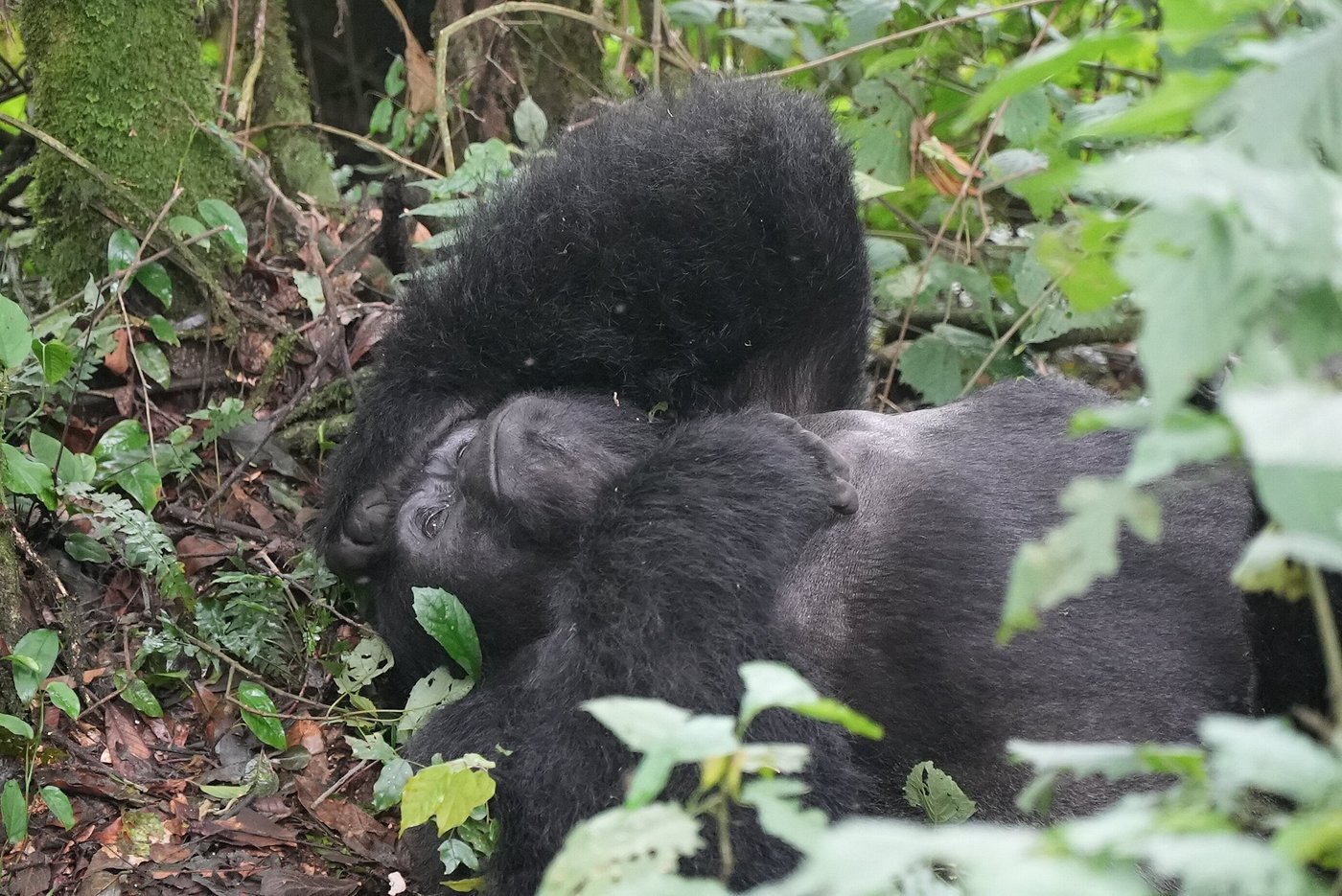
Before a gorilla family can be visited by tourists, it spends about two years being habituated. Researchers and trackers visit it daily until the gorillas accept people calmly at close range. Uganda is the only country that lets visitors join this process. The gorilla habituation experience takes place in Bwindi Impenetrable National Park's southern Rushaga sector, and it is the closest a traveller can get to seeing how gorilla conservation actually works.
| Standard trekking | Habituation experience | |
|---|---|---|
| Time with gorillas | 1 hour | Up to 4 hours |
| Group size | Up to 8 visitors | Up to 4 visitors |
| Gorilla family | Fully habituated | Semi-habituated, less predictable |
| Who leads | Ranger guides | Researchers, trackers and rangers |
| Permit (foreign non-resident, 2026) | US$800 | US$1,500 (announced US$1,800 from 1 January 2027) |
| Availability | Many permits daily across Bwindi and Mgahinga | Very few permits per day |
You report early to the Rushaga sector headquarters and set out with the habituation team to the spot where the family nested the night before. You may then follow the trail they have left while feeding: crushed vegetation, dung, discarded stems. Once you reach them, you spend up to four hours watching and learning how the team logs behaviour, identifies individuals by their nose prints, and gradually closes the distance. Because the gorillas are less used to people, you will see more natural behaviour, and occasionally a silverback's mock charge. The rangers' instructions are absolute.
It is a long day, often 6–10 hours including walking, in thick forest. Fitness matters more than on a standard trek, and the minimum age is still 15.
With only a handful of habituation permits a day, book at least 6 months ahead for peak months. It combines naturally with a standard trek on another day, so you see one fully habituated family and one in progress. Our 3-day gorilla habituation safari starts from Entebbe or Kigali. We cover the trade-offs in more depth in trekking vs habituation.
Habituation is a slow, careful process. A team of trackers and researchers finds the family every day and stays with it a little longer each time, keeping a respectful distance and repeating calm, predictable behaviour. At first the gorillas flee, hide or charge. Over months, they start to ignore the observers and carry on feeding, resting and playing. The whole process usually takes around two years. Veterinary teams monitor the group throughout, because contact with people increases the risk of disease. Only when the family is fully calm around visitors does the wildlife authority open it for standard trekking.
By joining a habituation visit, you become part of that process for a day. You see the tracking methods, the data being recorded and the early, less predictable behaviour that standard trekkers never witness.
Our 3-day gorilla habituation safari follows this plan. Longer trips such as the 10-day gorilla and primates safari can swap a standard trek for habituation on request.
Stay in or close to Rushaga, so that the early start doesn't become a pre-dawn drive. Rushaga has lodges from community guesthouses to upmarket lodges overlooking the forest, and Lake Bunyonyi and Lake Mutanda are within 1½ hours. See lodges in Rushaga and things to do in Rushaga.
The longer time frame changes photography completely. You have time to wait for a gorilla to look up, for light to break through the canopy, or for young gorillas to start playing. Bring a camera that handles high ISO well, a zoom in the 70–200 mm range, spare batteries and a rain cover. Flash is still banned. The group is only four people, so there is usually room to find an angle without crowding.
Compare them in detail in gorilla trekking vs habituation, and read the background in gorilla habituation in Uganda.
The standard rules apply, and they matter even more with a less habituated family: stay behind the lead ranger, keep your voice low, never run if a gorilla charges, and follow every instruction immediately. Face masks may be required. The minimum age is 15, and trekkers who are unwell cannot join. See gorilla trekking rules.
During a habituation visit, the team logs how the family responds to people: how far away the silverback tolerates observers, how often the gorillas vocalise or charge, and how long they keep feeding without moving away. Trackers also note where the group nested, what it ate and how far it travelled. The team identifies individuals by their unique nose prints (the pattern of wrinkles above the nostrils), much as fingerprints are used for people. Visitors are encouraged to ask questions, and many guests say the insight into gorilla behaviour and ranger work is as memorable as the gorillas themselves.
Semi-habituated families are more likely to move away from people, so the team may have to follow them over several ridges. Expect off-trail walking through dense vegetation on steep, muddy ground at around 1,800–2,500 metres. Porters are available and strongly recommended. Good boots, gloves and gaiters matter even more than on a standard trek. See our packing list and fitness guide.
Rushaga sits in the far south-west of Uganda, close to Lake Bunyonyi, Lake Mutanda and Mgahinga Gorilla National Park. A habituation trip can therefore easily include golden monkey tracking, a volcano hike or a lake stay. Heading north, Queen Elizabeth National Park is about 4 hours away via Ishasha, and Kibale is further on for chimpanzees.
Every newly habituated family spreads tourism across more of the forest, which in turn means more ranger patrols, more monitoring and more income for communities around the park. Habituation also gives researchers detailed data on behaviour, health and ranging, which guides veterinary work and protection plans. The higher permit price reflects the smaller groups and the intensive staff time involved, and it helps fund the work that eventually opens new families to standard trekking.
In the Rushaga sector of southern Bwindi Impenetrable National Park, Uganda. Rwanda does not offer it.
US$1,500 for foreign non-residents in 2026. UWA has announced US$1,800 from 1 January 2027.
The gorillas are less predictable, so rangers keep strict control, but incidents involving visitors who follow instructions are extremely rare.
Yes, on separate days. It is a popular way to compare the two.
Up to four hours with the gorillas, plus the time taken to find them. Many habituation days run 6–10 hours in total.
A maximum of four visitors per family per day.
Rarely. With so few permits per day, book at least six months ahead for peak months.
For photographers, repeat visitors and anyone interested in primate behaviour, yes. Four hours with a group of just four visitors is a very different experience from a standard one-hour trek.
No. The minimum age is 15, the same as for standard gorilla trekking.
Four hours with a family still being habituated, in a group of four.
Both great apes in five days, with Queen Elizabeth on the way.
10-Day Uganda Gorilla and Primates Safari takes you to an expedition to the best destinations in Uganda.
12-day Uganda trip with Murchison Falls, Kibale chimp trekking, Queen Elizabeth wildlife, Bwindi gorilla trekking, Lake Bunyonyi & Lake Mburo National Parks.