
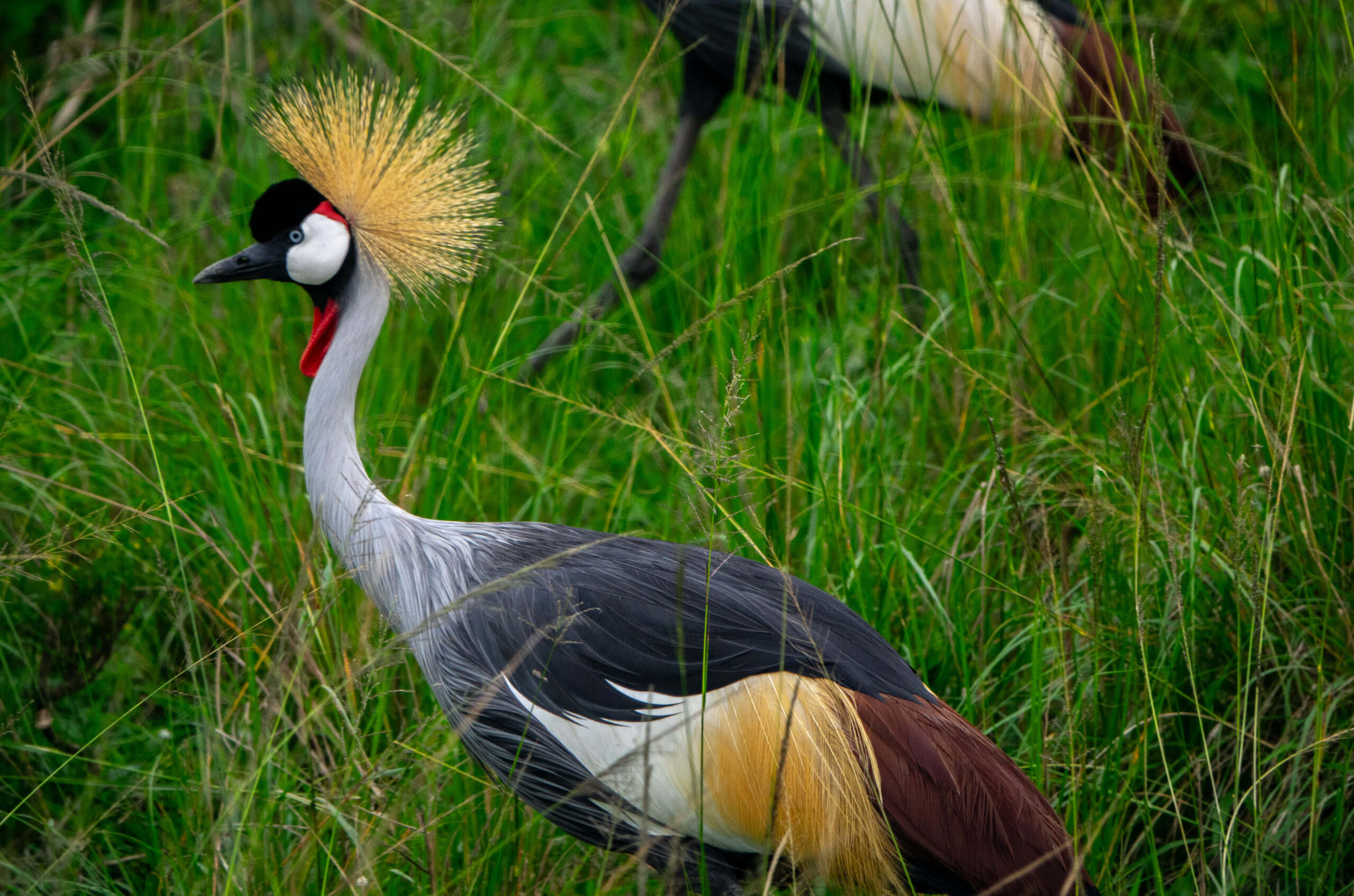
Birdwatchers’ Bucket List: Rare and Endemic Birds to See in Uganda, Uganda is one of Africa’s most exciting birding destinations. With more than 1,000 recorded bird species, a remarkable variety of habitats, and access to birds associated with the Albertine Rift, Uganda offers extraordinary opportunities for both first-time birdwatchers and serious birding enthusiasts.
For dedicated birdwatchers, however, the greatest attraction is not simply the number of species. It is the chance to search for rare, restricted-range and endemic birds that can turn an ordinary Uganda birding safari into a genuine birdwatching expedition.
From the papyrus wetlands of eastern Uganda to the montane forests of Bwindi and Mgahinga, Uganda contains habitats supporting some of Africa’s most sought-after birds.
And at the top of the country’s birding bucket list are Fox’s Weaver and Karamoja Apalis, Uganda’s two recognized endemic species.
Uganda’s Endemic Birds: What Does “Endemic” Really Mean?
 Before building a birding bucket list, it is important to understand the term endemic.
An endemic species is one that naturally occurs in a particular geographical area and nowhere else in the world.
Uganda has a relatively small number of true endemic bird species compared with its enormous overall bird diversity. Current bird checklists identify two endemic species:
- Fox’s Weaver (Ploceus spekeoides)
- Karamoja Apalis (Apalis karamojae) Avibase
Many other birds commonly promoted as Uganda “specials” are not technically endemic to Uganda. Instead, they may be:
- Albertine Rift endemics
- East African endemics
- Restricted-range species
- Rare species
- Species that are particularly difficult to find outside Uganda
- Birds for which Uganda provides some of the best viewing opportunities
For a serious birdwatcher, these distinctions matter—but they do not make the birds any less exciting.
Fox’s Weaver – Uganda’s Ultimate Endemic Bird
Scientific name: Ploceus spekeoides
Status: Near Threatened
Range: Uganda
If you could choose only one bird for your Uganda birding bucket list, Fox’s Weaver should be at the top.
This attractive but elusive weaver is Uganda’s best-known endemic bird. It is found nowhere else in the world, making a successful sighting particularly special. Uganda Wildlife Authority
Fox’s Weaver is associated with wetlands, seasonally flooded grasslands and wooded habitats, particularly in northeastern and eastern Uganda.
Important areas associated with the species include:
- Lake Bisina
- Lake Opeta
- Pian Upe
- Bokora
- Matheniko
- Other wetlands and wooded grasslands of northeastern Uganda Uganda Wildlife Authority
Why birdwatchers love it
Fox’s Weaver has an interesting conservation story. For many years, the species was extremely difficult to locate, leading to serious concern about its survival. More recent field observations have confirmed that the species still breeds in suitable wetland habitats. The Ornithologist
Finding one is therefore more than ticking another bird off a checklist.
It is an opportunity to see a bird that exists only in Uganda.
Where to look for Fox’s Weaver
A specialized birding trip toward Lake Bisina and Lake Opeta can be particularly rewarding.
Because the species inhabits wetlands and seasonally flooded areas, searching for it can involve difficult walking conditions, mud, tall vegetation and patience.
This is not necessarily a roadside bird.
It is a true birding expedition.
Karamoja Apalis – The Northeastern Uganda Specialty
Scientific name: Apalis karamojae
Range: Northeastern Uganda and the wider East African region
Status: Vulnerable
Karamoja Apalis is another exceptional bird on a Uganda birdwatcher’s bucket list.
However, there is an important distinction: unlike Fox’s Weaver, Karamoja Apalis is not restricted exclusively to Uganda. It is a highly restricted East African species associated particularly with the Karamoja region and neighboring areas. Uganda’s 2026 State of Wildlife report nevertheless recognizes it alongside Fox’s Weaver as one of the country’s two endemic bird species under its reporting framework, while the African Bird Club classifies it as an East African specialty rather than a strict Uganda-only endemic. Uganda Wildlife Authority
For travelers, the practical point is simple:
Karamoja Apalis is one of the birds you should target when exploring northeastern Uganda.
Its habitat includes dry wooded grasslands and areas dominated by whistling-thorn vegetation.
Why it belongs on your bucket list
Karamoja itself is an extraordinary birding destination.
The region offers a very different experience from Uganda’s famous rainforests. Instead of dense tropical vegetation, birders encounter:
Dry savannah, Rocky landscapes, Acacia and whistling-thorn woodland, Seasonal wetlands, Mountainous scenery, Semi-arid habitats
A Karamoja birding expedition can therefore combine spectacular scenery with some of Uganda’s most specialized birds.
Grauer’s Broadbill – An Albertine Rift Treasure
Scientific name: Pseudocalyptomena graueri
If your bucket list extends beyond strict Ugandan endemics, Grauer’s Broadbill should be near the top.
This extraordinary green bird is associated with the Albertine Rift, one of Africa’s most important centers of bird endemism.
Uganda’s Bwindi Impenetrable National Park is one of the places where specialist birders can search for this remarkable species.
Its green plumage can make it surprisingly difficult to locate among moss-covered branches and dense rainforest vegetation.
Best places to target it
Consider:
- Bwindi Impenetrable National Park
- Ruhija sector
- Buhoma sector
A specialized forest birding guide can make a major difference because many Albertine Rift species are easier to locate by call and behavior than simply by scanning the canopy.
African Green Broadbill
Scientific name: Pseudocalyptomena graueri
The African Green Broadbill is another highly desirable forest bird for specialist birders.
The Albertine Rift forests of southwestern Uganda provide an important opportunity to search for this type of restricted-range forest species. Uganda’s Albertine Rift forests are particularly valuable because several species with very limited global distributions occur within them. African Bird Club
Bwindi is therefore not simply a gorilla destination.
For birdwatchers, it is an entirely different world.
A single forest trail can produce:
- Broadbills
- Sunbirds
- Turacos
- Flycatchers
- Greenbuls
- Barbets
- Apalises
- Shrikes
- Other Albertine Rift specialties
- Shelley’s Crimson-wing
Scientific name: Cryptospiza shelleyi
For serious birdwatchers, Shelley’s Crimson-wing is one of the dream birds of southwestern Uganda.
It is associated with high-elevation forest habitats and can be extremely challenging to locate.
The bird’s secretive nature makes it a genuine prize for experienced birders.
A birding expedition through the montane forests of Bwindi and the wider Albertine Rift offers an opportunity to search for this and other high-altitude specialties.
The reward is not guaranteed—and that is precisely what makes the search memorable.
Blue-headed Sunbird
Scientific name: Cyanomitra alinae
The Blue-headed Sunbird is another highly desirable Albertine Rift specialty.
Its iridescent blue head contrasts beautifully with its darker body, making it one of the more attractive sunbirds encountered in Uganda’s montane forests.
The forests around:
- Bwindi
- Mgahinga
- Albertine Rift montane habitats
are among the areas birders explore when targeting Uganda’s restricted-range forest birds.
Yellow-eyed Black-Flycatcher
Scientific name: Muscicapa lendu
The Yellow-eyed Black-Flycatcher is a striking dark forest bird with a conspicuous pale-yellow eye.
It is another bird that demonstrates why Uganda is so important to specialist birdwatchers.
Unlike large, obvious species such as the Shoebill, many forest specialties require:
- Patience
- Quiet observation
- Knowledge of bird calls
- Early starts
- Experienced local guides
The reward can be a brief but unforgettable view through binoculars.
Strange Weaver
Scientific name: Ploceus alienus
The Strange Weaver is another bird to add to a serious Uganda forest-birding checklist.
Its dark head and contrasting yellowish body make it attractive, but its forest habitat means that finding it requires more than simply visiting a popular wildlife park.
This is particularly true for visitors whose primary experience of Uganda has been savannah safaris.
Uganda’s montane forests contain a completely different bird community.
Willard’s Sooty Boubou
Another Albertine Rift specialty worth targeting is Willard’s Sooty Boubou.
It is among the birds listed by the African Bird Club as an Albertine Rift endemic occurring in Uganda.
Like many forest boubous, it can be difficult to see clearly in thick vegetation.
Listening carefully for calls can therefore be just as important as scanning the branches.
Green-breasted Pitta – Uganda’s Legendary Forest Prize
Scientific name: Pitta reichenowi
For many birdwatchers, the Green-breasted Pitta is one of the ultimate African birding targets.
It is not endemic to Uganda, but Uganda offers important opportunities to search for this highly desirable forest bird.
The species is particularly associated with lowland rainforest habitats.
For specialist birders, forests around Budongo and Kibale can form part of a broader itinerary designed around Uganda’s forest birds.
Finding a pitta can be a highlight of an entire safari.
Kidepo Lark – A Northeastern Uganda Specialty
Scientific name: Mirafra hypermetra
The northeastern part of Uganda provides a completely different birding experience from Bwindi.
In the dry landscapes around Kidepo Valley, birders can search for species adapted to semi-arid conditions, including the highly desirable Kidepo Lark.
This is one reason a comprehensive Uganda birding itinerary should not concentrate entirely on the country’s rainforests.
Uganda’s bird diversity comes partly from the extraordinary transition between:
- Tropical rainforest
- Albertine Rift mountains
- Wetlands
- Savannah
- Dry northeastern plains
Papyrus Gonolek – A Wetland Bucket-List Bird
Scientific name: Laniarius mufumbiri
The bright Papyrus Gonolek is one of Uganda’s most attractive wetland birds.
It has vivid red, black and yellow coloration and is associated with papyrus wetlands.
Uganda has extensive wetland habitats, making it an excellent destination for papyrus specialists. Uganda’s tourism information identifies several papyrus-associated birds, including Papyrus Gonolek, Papyrus Canary, White-winged Warbler and Papyrus Yellow Warbler. Tourism Uganda
Good birding areas include wetlands around:
- Queen Elizabeth National Park
- Lake Victoria
- Entebbe
- Mabamba
- Other papyrus wetlands
Shoebill – The Ultimate Uganda Birding Icon
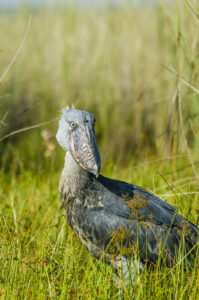
No Uganda birding bucket list would be complete without the Shoebill.
The Shoebill is not endemic to Uganda, but Uganda is one of the world’s best destinations for seeing it
This enormous prehistoric-looking bird is especially associated with wetlands and marshes.
Some of the most important areas for Shoebill encounters include:
- Mabamba Swamp
- Murchison Falls National Park
- Lake Victoria wetlands
- Other large papyrus and marsh habitats
For many international birdwatchers, seeing a Shoebill in Uganda becomes one of the defining moments of their safari.
Uganda’s Best Regions for a Rare-Birding Bucket List
Bwindi Impenetrable National Park
Bwindi is one of Uganda’s greatest destinations for Albertine Rift endemics.
Birders can combine their search for rare forest species with gorilla trekking.
Target species may include:
Grauer’s Broadbill, Blue-headed Sunbird, Shelley’s Crimson-wing Yellow-eyed Black-Flycatcher, Various Albertine Rift specialties
Kidepo Valley and Karamoja
For rare dry-country birds, northeastern Uganda is difficult to beat.
This region is especially attractive for birders searching for:
- Karamoja Apalis
- Kidepo Lark
- Fox’s Weaver in suitable eastern/northeastern habitats
- Other dry-country specialties
The scenery and cultural experiences also make this a remarkable addition to a Uganda birding safari.
Lake Bisina and Lake Opeta
If Fox’s Weaver is your number-one target, eastern Uganda deserves special attention.
These wetlands are strongly associated with the species and have been the focus of surveys and birding expeditions.
This is not necessarily a conventional tourist excursion.
It is better approached as a specialist birding expedition with an experienced local guide.
Mabamba Wetland
Mabamba is famous internationally for the Shoebill.
Its proximity to Entebbe also makes it an excellent first or final birding stop for travelers arriving through Uganda’s main international gateway.
A canoe excursion through the papyrus channels can provide excellent opportunities for wetland bird photography.
Murchison Falls National Park and Budongo Forest
This region combines:
Savannah birds, Riverine species, Wetland birds, Forest species
The famous Royal Mile in Budongo Forest is particularly important for forest birding.
It can be incorporated into a longer Uganda birding itinerary covering both western rainforest and northern savannah habitats.
A Suggested Uganda Birdwatchers’ Bucket List
For a serious birder planning a Uganda safari, consider making these your priority targets:
| Bird | Why Target It? | Suggested Region |
|---|---|---|
| Fox’s Weaver | Uganda’s true endemic | Lake Bisina/Opeta |
| Karamoja Apalis | Highly restricted East African specialty | Karamoja |
| Grauer’s Broadbill | Albertine Rift specialty | Bwindi |
| Shelley’s Crimson-wing | Rare montane forest target | Bwindi |
| Blue-headed Sunbird | Albertine Rift specialty | Bwindi/Mgahinga |
| Yellow-eyed Black-Flycatcher | Striking restricted-range forest bird | Bwindi |
| Willard’s Sooty Boubou | Albertine Rift specialty | Southwestern Uganda |
| Kidepo Lark | Northeastern specialty | Kidepo/Karamoja |
| Papyrus Gonolek | Papyrus wetland specialty | Wetlands/Queen Elizabeth |
| Shoebill | One of Africa’s greatest birding prizes | Mabamba/Murchison |
The exact species encountered will depend on season, habitat, weather, guide expertise and current local conditions.
When Is the Best Time for Rare Birding in Uganda?
Uganda can be excellent for birdwatching throughout much of the year, but different seasons offer different advantages.
The November to April period is particularly interesting because migratory birds are present, adding another dimension to Uganda’s resident bird diversity. SafariBookings.com
For specialist forest birding, however, the most important factor is often where you go rather than simply when you go.
If your target is Fox’s Weaver, for example, you should build the itinerary around its habitat rather than simply choosing the country’s most popular safari season.
Why Hire a Specialist Birding Guide?
Finding rare birds is very different from seeing large mammals on a conventional safari.
An experienced birding guide can help you:
Identify birds by their calls, Locate birds hidden inside vegetation, Know where particular species occur Recognize feeding and nesting behavior, Identify subtle plumage differences, Choose productive trails, Adjust the itinerary according to recent sightings, Record your sightings accurately
For difficult species such as Fox’s Weaver and Albertine Rift forest specialties, local knowledge can make the difference between hearing a bird and actually seeing it.
Build Your Ultimate Uganda Birding Safari
Uganda is much more than a destination for gorillas, chimpanzees and the Big Five.
For birdwatchers, it is a country of wetlands, tropical forests, mountains, savannahs and dry northeastern landscapes, each supporting a different collection of species.
The ultimate bucket-list experience could begin with a search for Fox’s Weaver around Lake Bisina or Lake Opeta, continue through the dry landscapes of Karamoja and Kidepo, move into the forests of Budongo and Kibale, and finish among the Albertine Rift specialties of Bwindi and Mgahinga.
And while Uganda has only a small number of true endemic birds, the country offers something arguably even more exciting for a serious birder: an extraordinary concentration of restricted-range African species within one relatively accessible destination. The African Bird Club lists numerous Albertine Rift and Uganda specialties alongside the country’s two endemics.
Plan Your Uganda Birding Safari with Fuga Tours and Travel
Whether your dream is to photograph Fox’s Weaver, search for Karamoja Apalis, explore the Albertine Rift for rare forest birds, or combine birdwatching with gorilla and chimpanzee trekking, Uganda can be tailored into a specialist birding adventure.
Book or plan your Uganda birding safari with Fuga Tours and Travel and create an itinerary around the species and habitats you most want to see.
From the wetlands of eastern Uganda to the misty forests of Bwindi and the remote landscapes of Karamoja, your birdwatching bucket list can become a real Ugandan adventure.
Species classifications and distributions can change as taxonomic authorities update their checklists. For this reason, this article distinguishes strict Uganda endemics from Albertine Rift and other restricted-range specialties rather than describing every rare Ugandan bird as “Uganda-only.”